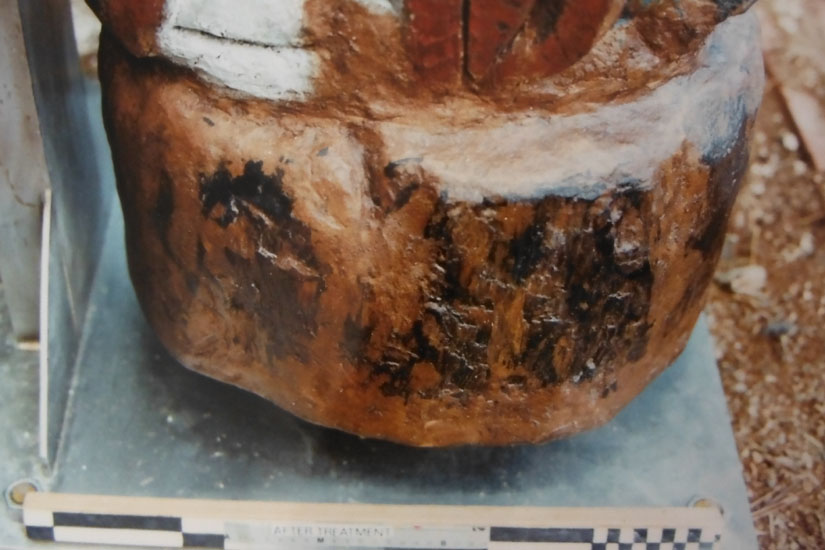
Yesterday was the last day that Andrew was working on the Totem Pole. He had a few finishing touches and he was going to be done.
At this almost finished state the Totem Pole looks great. The colours are vibrant and the Raven, Chief, Frog and Whale are looking fantastic.
The last part to finish is the Whale, since it was the most damaged, but I'm really surprised at how good it looks even at this stage. Andrew did a great job with the Totem Pole, and we wish him a safe journey home back to Canada. Hopefully he'll be able to return soon to see the Totem Pole standing once again.
Showing posts with label restoration. Show all posts
Thursday, November 1, 2012
Thursday, October 11, 2012
The Metal Base
As you can see from this photo, the Chief's Crest Pole has a bit of support in the back to help keep it standing.
The metal base consists of two small spikes in the back of the pole covered in some kind of plaster and attached to a tower in the back.
There is also a large metal base designed to keep the Chief's Crest Pole off of the ground and away from excess moisture.
I managed to find several sketches of this structure in the Embassy of Canada's archives.
It appears that there are the two spikes in the back, and one larger one in the base. While this base provided much need support while it was up in the garden, it's now creating a bit of a problem in restoration. To repair the Pole properly it must be lying down, this creates a great deal of stress on the two bolts in the back, and made it much more difficult to rest on the work benches. This base may also create problems when the Pole has to be moved later on. There are several ideas about what can be done, and how this will affect the future of the Chief's Crest Pole.
The metal base consists of two small spikes in the back of the pole covered in some kind of plaster and attached to a tower in the back.
There is also a large metal base designed to keep the Chief's Crest Pole off of the ground and away from excess moisture.
I managed to find several sketches of this structure in the Embassy of Canada's archives.
It appears that there are the two spikes in the back, and one larger one in the base. While this base provided much need support while it was up in the garden, it's now creating a bit of a problem in restoration. To repair the Pole properly it must be lying down, this creates a great deal of stress on the two bolts in the back, and made it much more difficult to rest on the work benches. This base may also create problems when the Pole has to be moved later on. There are several ideas about what can be done, and how this will affect the future of the Chief's Crest Pole.
Wednesday, October 10, 2012
Past Restorations
While going through the archives of the Chief's Crest Pole, I discovered that this is not the first time that this Pole was repaired. In 2001 it appears that a restoration effort was made. This was also likely the time that the metal base was added. The problems that came up during this restoration seem very similar to those that are here now. Moisture and heat caused cracking, moss growth, paint chipping, and even the possibility of ants. Bellow are several before and after photos from the last restoration:
The base before.
The base after.
The hat before.
The hat after.The top of the hat before.
The top of the hat after.
The Chief's face before.
The Chief's face after.
The future of the Chief's Crest Pole is one that will keep it much safer than it's been in the past. In the near future, after the restoration is complete, it will stay up at the Benaki museum. After this time, the Canadian Embassy will look for a permanent home (possibly in their Embassy) were the Pole will be indoors and away from the elements.
Tuesday, October 9, 2012
The Start Of The Restoration
Now that the Chief's Crest Pole is safely in it's studio, Andrew Todd has started to work on restoring this piece of Canadian culture back to it's former glory. The work is very detail oriented and time consuming, but it's coming along very well.
This first step is to clean and remove any debris and paint that is just too damaged to repair. In most cases this damaged material is from past restoration work that had been done many years ago.
Along with a vacuum and several brushes, Andrew's main tool of choice is a simple wooden stick. He uses this stick to remove debris that is loose. Wooden tools to not scratch or damage the original wood of the Totem Pole, and are very gentle on the paint as well.
While some of the loose debris is simply thrown out, some is to valuable to simply be disposed. In these cases Andrew must re-attach these pieces using wood glues.
Andrew is also not simple eliminating all of the past restoration work. For example, many of the cracks have been filled with these small slivers of wood. These are likely from a past restoration, and where ever possible Andrew is leaving these.
This is a time for Andrew to explore the Chief's Crest Pole, and find out what kind of condition it is truly in. So far he's optimistic, and let's hope it stays that way.
Remember, if you want to see Andrew Todd at work, you can visit the Benaki Museum at 138 Pireos street, Thursday to Sunday's. You can see more photos from his work on our Facebook page, and you can also see Andrew Todd's lecture at the Canadian Institute in Greece on October 17th.
This first step is to clean and remove any debris and paint that is just too damaged to repair. In most cases this damaged material is from past restoration work that had been done many years ago.
Along with a vacuum and several brushes, Andrew's main tool of choice is a simple wooden stick. He uses this stick to remove debris that is loose. Wooden tools to not scratch or damage the original wood of the Totem Pole, and are very gentle on the paint as well.
While some of the loose debris is simply thrown out, some is to valuable to simply be disposed. In these cases Andrew must re-attach these pieces using wood glues.
Andrew is also not simple eliminating all of the past restoration work. For example, many of the cracks have been filled with these small slivers of wood. These are likely from a past restoration, and where ever possible Andrew is leaving these.
This is a time for Andrew to explore the Chief's Crest Pole, and find out what kind of condition it is truly in. So far he's optimistic, and let's hope it stays that way.
Remember, if you want to see Andrew Todd at work, you can visit the Benaki Museum at 138 Pireos street, Thursday to Sunday's. You can see more photos from his work on our Facebook page, and you can also see Andrew Todd's lecture at the Canadian Institute in Greece on October 17th.
Tuesday, October 2, 2012
The First Cleaning, Spay, and Inspection
Today was the first day of restoration on the Chief's Crest Pole. After spending a month in storage the Chief's Crest Pole was carefully unwrapped.
Andrew Todd, a Canadian restoration expert from British Columbia, has come to Athens to repair the Chief's Crest Pole. The first step is to carefully inspect and clean the Pole to asses what kind of damage there is, and to make sure any dust and dirt is removed.
Every single nook and cranny has to be meticulously cleaned out. This is important because if the Chief's Crest Pole has dirt in the cracks it will make it harder for the ant spray to go deep into the center where the ants are hiding.
When Andrew Todd was happy with the cleaning, he started to spray. The spay is a product known as Tim-Bor, and it has "been researched and approved by many conservation science labs, and continues to be used effectively in the museum world for wooden objects especially." It is apparently only dangerous for wood boring insects. As soon as the spray was applied, the ants started to scatter. The hope is that the ants will be gone and by Wednesday the Chief's Crest Pole will be moved to the final work space.
Andrew Todd, a Canadian restoration expert from British Columbia, has come to Athens to repair the Chief's Crest Pole. The first step is to carefully inspect and clean the Pole to asses what kind of damage there is, and to make sure any dust and dirt is removed.
Every single nook and cranny has to be meticulously cleaned out. This is important because if the Chief's Crest Pole has dirt in the cracks it will make it harder for the ant spray to go deep into the center where the ants are hiding.
When Andrew Todd was happy with the cleaning, he started to spray. The spay is a product known as Tim-Bor, and it has "been researched and approved by many conservation science labs, and continues to be used effectively in the museum world for wooden objects especially." It is apparently only dangerous for wood boring insects. As soon as the spray was applied, the ants started to scatter. The hope is that the ants will be gone and by Wednesday the Chief's Crest Pole will be moved to the final work space.
Thursday, September 27, 2012
The Benaki Museum Space
After many years, the Totem Pole has been moved to the Benaki museum. This museum houses some of the great works of art by fine artists all over the world. The experts that take care of this museum are familiar with many different forms of restoration, so the Totem Pole is in good hands.
While the Totem Pole is being fumigated for ants, there is a space waiting for its arrival. The plan is to have the Totem Pole on display as it's being restored. This open space will allow the public to watch the restoration in person, as well as allow school children to interact and learn more about this Canadian art form. If you come and visit, you'll be able to talk with Andrew Todd, the Totem Pole restoration expert that will be coming from Canada to do this work. The Benaki museum is also planning several interactive lectures with Mr Todd.Now this space is empty, but soon it will be a place to watch a piece of Canadian heritage being restored.
Subscribe to:
Posts (Atom)